
TL;DR: In Florida, a hit-and-run where the fleeing car struck yours and a "phantom vehicle" crash where it never touched you can both lead to an uninsured motorist (UM) claim under your own policy, if that coverage is on the policy. The Florida Supreme Court has held that a policy's physical-contact requirement cannot defeat that coverage, and a Florida appellate court has refused to enforce a policy clause demanding independent corroboration, noting that Florida has no statute requiring it. The injured driver still has to prove the crash happened as described, so independent evidence such as a 911 call, a crash report, video, or a witness often makes the difference.
The car that cut across three lanes on I-275 never touched yours. It was just gone, and now you're the one in the ditch with a neck that won't turn. The holiday trip that was supposed to end at a family table ended on the shoulder instead, with flashing lights and a question no one at the scene could answer: who pays when the person who caused this has disappeared? That question can feel like a locked door. It isn't. A missing driver creates a problem of proof. It does not leave the injured person without a path forward. Florida law has an answer for this situation, and it begins with understanding which kind of crash actually happened.
Hit-and-Run Claim or Phantom Vehicle: Two Crashes, One Question
Both situations involve a driver who leaves. The difference is what happened before they left.
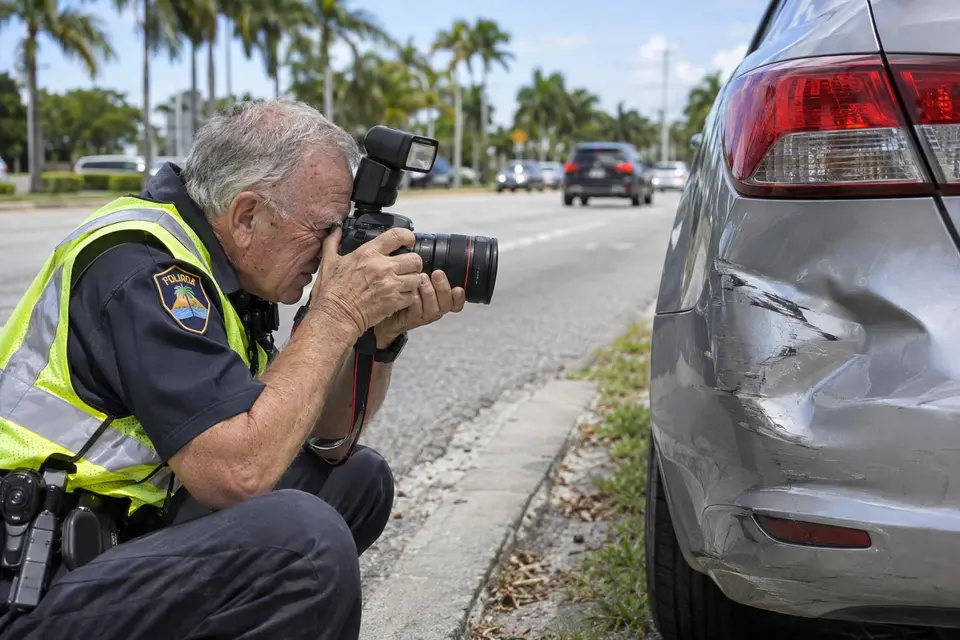
In a contact hit-and-run, the other vehicle strikes the injured driver's car and keeps going. There is usually physical evidence: crushed metal, paint transfer, broken glass, a dented bumper that tells part of the story on its own.
In a no-contact or "phantom vehicle" crash, the other driver forces a swerve, a hard brake, or a spin into a guardrail or ditch without ever touching the injured driver's car. The damage is real and the injuries are real, but nothing on the car points to a second vehicle.
Florida law expects a driver involved in an injury crash to stay. Under Fla. Stat. § 316.027, a driver involved in a crash that results in injury must stop at the scene and remain until fulfilling the duties in § 316.062, which include giving name, address and registration information and rendering reasonable aid. When that driver flees, the injured person is left without anyone to pursue directly. That is the gap uninsured motorist coverage can fill.
The Physical-Contact Myth and What Florida Law Actually Says
A common belief holds that a no-contact crash is not a "real" hit-and-run claim, or that Florida demands an independent witness before a phantom vehicle claim can go forward. Insurance policies have sometimes been written to say exactly that. Florida courts have refused to enforce those limits.
In Brown v. Progressive Mutual Insurance Co., 249 So. 2d 429 (Fla. 1971), the Florida Supreme Court held that a policy condition limiting hit-and-run UM coverage to crashes involving physical contact cannot defeat coverage under Florida's UM statute. The court said the statute exists to protect injured people, not insurers, and that an insured who carries the burden of proving the accident occurred may recover regardless of whether there was physical contact. Whether the crash happened as described is a question of fact for a jury, or a judge if no jury is demanded.
A Florida appellate court went further in Massa v. Southern Heritage Insurance Co., 697 So. 2d 868 (Fla. 4th DCA 1997). The policy there would accept, in no-contact cases, only evidence other than the claimant's own testimony. The court held that provision unenforceable as a matter of law and noted that Florida, unlike some other states, has no statute requiring corroboration. The Florida Supreme Court later reaffirmed the broader principle in Young v. Progressive Southeastern Insurance Co., No. SC93544 (Fla. Feb. 10, 2000): UM policy provisions giving less coverage than the statute requires are void as contrary to public policy.
One point deserves care, though. These decisions remove contact and corroboration as contractual hurdles. They do not remove the burden of proof. The injured driver still has to show that a second vehicle caused the crash. Independent evidence is not legally required, but it is often what makes that burden easier to carry.
Uninsured Motorist Coverage in Florida: Where the Missing Driver's Responsibility Lands
When the at-fault driver vanishes, the claim usually turns inward, toward the injured driver's own policy. Under Fla. Stat. § 627.727(1), a motor vehicle policy that provides bodily injury liability coverage for a vehicle registered or principally garaged in Florida must include UM coverage unless a named insured rejected it in writing on an approved form. That rejection can bind everyone insured under the policy, so the first practical step is confirming whether UM coverage is actually on the policy, and at what limits. Not every Florida driver has it.
Two other features of Florida UM coverage matter early:
- It sits on top of PIP. UM coverage is over and above personal injury protection, medical-payments, and similar benefits, and does not duplicate them.
- PIP comes first and has its own clock. Under Fla. Stat. § 627.736, PIP medical benefits generally apply only if initial care is received within 14 days after the accident, from a listed provider, hospital, or emergency transport service.
That 14-day window matters even more when the injury is a stiff neck that seemed manageable on the drive home. Delayed symptoms are common after a sudden swerve or impact, and the record of when treatment began often shapes how the injury is viewed later. The connection between soft tissue injury diagnosis timing and how insurers evaluate a claim is worth understanding before a gap in care becomes an argument against it.
Building the Proof in a Phantom Vehicle Case
Because a no-contact crash leaves no paint on the fender, the story has to be told in other ways. Evidence that supports a second vehicle's role often includes:
- The 911 call recording, especially one made in the first minutes describing the other car
- The Florida traffic crash report and any officer notes about the injured driver's account
- Dashcam footage, nearby business cameras, or traffic and toll-plaza video along I-275, I-4 or the Howard Frankland
- Names and phone numbers of other drivers who stopped or saw the maneuver
- Skid marks, tire tracks and scene photos showing an evasive path
- Emergency room and follow-up records describing how the injury occurred
Much of this disappears quickly. Private video is often recorded over within days, and witnesses scatter during busy holiday traffic. Reporting the crash helps preserve the official record. Under Fla. Stat. § 316.065(1), a driver involved in a crash resulting in injury must notify law enforcement immediately by the quickest means, and that duty applies to the injured driver who stayed at the scene, too.
Consider a hypothetical: a Brandon driver heading home after Thanksgiving swerves to avoid a sedan that cuts across three lanes on I-275 near downtown Tampa. Her SUV leaves the road and strikes a drainage embankment. No vehicle touches hers. She calls 911 while still in the car and describes a silver sedan with no front plate. A trucker pulls over and gives the responding trooper his number. Weeks later, her insurer questions whether another car was involved. The 911 recording, the trooper's report, and the trucker's account together tell the story her damaged SUV cannot. Florida law did not require that corroboration for her UM claim, but each piece makes her account harder to dismiss.
Notice and Deadlines in Florida UM Claims
Most policies require prompt notice of an accident. In Bankers Insurance Co. v. Macias, 475 So. 2d 1216 (Fla. 1985), the Florida Supreme Court held that when an insured breaches a notice provision, prejudice to the insurer is presumed, and the insured carries the burden of showing there was none. Late notice does not automatically end a claim, but it adds a hurdle that prompt notice avoids.
Time limits also deserve attention. Florida's deadline for negligence actions is now two years under Fla. Stat. § 95.11(5)(a). In Woodall v. Travelers Indemnity Co., 699 So. 2d 1361 (Fla. 1997), the Florida Supreme Court held that a UM claim accrues on the date of the accident and applied the five-year period for written contracts. That decision predates the 2023 shortening of the negligence period, and it is not clear how the two rules interact today. Treating the earlier deadline as the real one is the safest assumption.
Insurers sometimes request recorded statements, sworn statements, or proof of efforts to identify the other driver. Each request deserves careful thought, because a hurried answer given while still in pain can be read back later as an inconsistency. A Tampa car accident attorney can review the policy language, handle those communications, and keep the evidence gathering ahead of the deadlines.
The driver who fled took their name and insurance information with them. They did not take away the injured person's claim. Whether there was contact or not, the questions that matter are the same: Is UM coverage on the policy? What evidence shows a second vehicle caused the crash? Has the insurer been notified, and is treatment documented? Each of those questions has an answer, and none of them requires facing the insurer alone.
Closing Remarks
If a driver forced you off the road without ever touching your car, if your insurer is questioning whether another vehicle was really there, or if the 911 call, the video, and the witness who stopped are still waiting to be secured, the steps taken in the coming weeks will shape whether your account is believed.
You do not have to face this alone: CDB Injury Law helps Tampa Bay drivers hurt by hit-and-run and phantom vehicle crashes build the proof their UM claims need, so contact us today and let us talk about your recovery.
Frequently Asked Questions
Does Florida require physical contact for a hit-and-run UM claim?
No. The Florida Supreme Court held in Brown v. Progressive that a policy's physical-contact requirement cannot defeat UM coverage. A no-contact crash can still support a UM claim, as long as the injured driver can prove the crash happened as described.
Is an independent witness required in a Florida phantom vehicle claim?
Not as a legal requirement. Florida has no corroboration statute, and a Florida appellate court in Massa held a policy clause demanding evidence beyond the claimant's own testimony unenforceable. Independent evidence still carries real weight, because the injured driver must prove the facts of the crash to a jury or judge.
What if there is no uninsured motorist coverage on the policy?
Florida requires UM coverage with bodily injury liability policies unless a named insured rejected it in writing on an approved form. Whether a valid rejection exists is worth confirming by reviewing the policy and the signed form. PIP benefits may still apply to early medical bills and lost income, subject to the 14-day initial care rule.
Does reporting the crash late hurt a UM claim?
It can complicate one. Florida law requires drivers in injury crashes to notify law enforcement immediately, and under Bankers Insurance Co. v. Macias, late notice to an insurer creates a presumption of prejudice that the insured must rebut. Late notice does not automatically end a claim, but prompt reporting avoids that added burden.
How long is there to act after a Florida hit-and-run?
Florida's negligence deadline is two years under § 95.11(5)(a). UM claims against an insurer have been treated as contract claims accruing on the accident date, but it is not clear how that rule interacts with the shortened negligence period. Acting well within two years is the safest course.
References
- Crash involving death or personal injuries (Fla. Stat. § 316.027)
- Duty to give information and render aid (Fla. Stat. § 316.062)
- Brown v. Progressive Mutual Insurance Co., 249 So. 2d 429 (Fla. 1971)
- Massa v. Southern Heritage Insurance Co., 697 So. 2d 868 (Fla. 4th DCA 1997)
- Young v. Progressive Southeastern Insurance Co., No. SC93544 (Fla. Feb. 10, 2000)
- Motor vehicle insurance; uninsured and underinsured vehicle coverage; insolvent insurer protection (Fla. Stat. § 627.727)
- Required personal injury protection benefits; exclusions; priority; claims (Fla. Stat. § 627.736)
- Crashes; reports; penalties (Fla. Stat. § 316.065)
- Bankers Insurance Co. v. Macias, 475 So. 2d 1216 (Fla. 1985)
- Limitations other than for the recovery of real property (Fla. Stat. § 95.11)
- Woodall v. Travelers Indemnity Co., 699 So. 2d 1361 (Fla. 1997)