
TL;DR: If you were struck while crossing midblock outside a marked crosswalk, Florida law required you to yield to vehicles on the roadway. It also required the driver to use due care to avoid hitting you. An officer's note that you “weren't in a crosswalk” does not settle whether the driver could see you in time to slow down or give a warning. Those facts matter when deciding fault.
The report arrives, and a single line seems to settle everything: she wasn't in a crosswalk. A family reads it in a hospital waiting room, or at a kitchen table in the weeks after a funeral, and the question they were carrying — whether anyone owed her more care than that — quietly goes unasked. Bills keep arriving. The insurer sounds certain. The silence starts to feel like an answer. It isn't one. Who had the right-of-way is a different question from whether the driver used reasonable care.
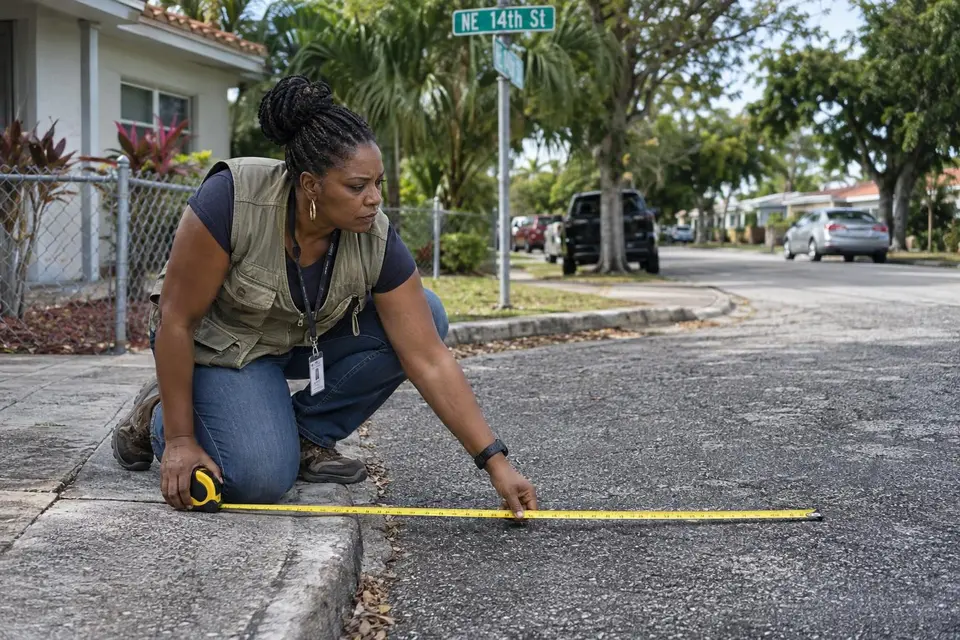
The Officer's Comment Is a Beginning, Not a Finding of Civil Fault
A crash involving death, personal injury, or complaints of pain calls for a Long Form report under Fla. Stat. § 316.066(1). For a family considering a civil claim, it matters who supplied the information and why. Under § 316.066(4), a crash participant's own required report and statements that participant makes to an officer to complete the required report generally cannot be used as evidence at trial. That protection does not, by its terms, cover everything the officer personally observed.
Two things follow. First, the phrase "not in a crosswalk" describes a location; it does not decide who was at fault. Second, the location itself is sometimes misread. Under the definition of "crosswalk" in Fla. Stat. § 316.003, a crosswalk exists at an intersection within the connections of the lateral lines of the sidewalks on opposite sides of the road — no paint required. A marked crosswalk can also exist away from an intersection, midblock, where lines or markings distinctly indicate a pedestrian crossing. A scene photograph may show whether the pedestrian was within those sidewalk lines at the intersection or farther down the block.
It also matters what kind of rule was involved. Under § 316.130(19), a pedestrian's violation of that section is a noncriminal traffic infraction. It is not a criminal judgment, and it does not carry a civil verdict inside it.
What Drivers Still Owe Outside a Crosswalk in Florida
Subsection (10) of Fla. Stat. § 316.130 says a pedestrian crossing outside both marked crosswalks and unmarked intersection crosswalks must yield the right-of-way to all vehicles on the roadway. But subsection (15) opens with the words notwithstanding other provisions of the chapter, and then requires every driver to exercise due care to avoid colliding with any pedestrian, to give warning when necessary, and to exercise proper precaution upon observing a child or an obviously confused or incapacitated person. Outside a crosswalk, the driver owes that duty of care even though the pedestrian must yield.
Several traffic rules help explain what to look for in the moments before impact:
- Speed suited to the conditions. No person may drive faster than is reasonable and prudent under the conditions, with regard to actual and potential hazards (Fla. Stat. § 316.183(1)), and an appropriately reduced speed is required when any special hazard exists involving pedestrians, weather, or highway conditions (§ 316.183(4)(e)).
- Slowing below the posted limit. Driving under the limit does not relieve the duty to decrease speed when special hazards exist or may exist, or when approaching and crossing an intersection, rounding a curve, approaching a hill crest, or traveling a narrow or winding road (Fla. Stat. § 316.185).
- Lighted lamps. A vehicle being driven on a Florida highway generally must display the lights required for its class from sunset to sunrise, including twilight, and during any rain, smoke, or fog (Fla. Stat. § 316.217(1)).
- Careful and prudent operation. Driving must have regard for width, grade, curves, corners, traffic, and all other attendant circumstances, so as not to endanger life or limb (Fla. Stat. § 316.1925).
- Attention. Florida generally prohibits manually typing, sending, or reading texts or emails while driving a moving motor vehicle (Fla. Stat. § 316.305(3)). That is not a statewide ban on all handheld use; navigation, for example, is an exception to the texting statute. A separate rule restricts handheld use in designated school crossings, school zones, and work zones (§ 316.306).
A collision does not by itself mean the driver failed to use due care. The collision-avoidance language in the speed statutes refers to people on or entering the road in compliance with legal requirements and the duty to use due care. Section 316.130(8) also forbids a pedestrian from suddenly leaving a curb or other place of safety and entering the path of a vehicle so close that yielding is impossible. Two questions matter here: how much time did the driver reasonably have to react, and what did the driver do in that time?
Lighting, Road Design, and the Shape of the Roadway
People cross midblock where life is arranged that way: a bus stop on one side, apartment entrances on the other, a grocery cart, a shift that ends after dark. That pattern is not a moral fact about the person crossing. It is a fact about the road, and it belongs in the analysis alongside the driver's speed and lamps.
Consider a four-lane road with a bus stop opposite an apartment entrance. The nearest intersection is lit, but the stretch by the stop is dark. A driver moves through steady rain at the posted limit. A person in dark clothing steps into the westbound lane. Where the person crossed matters, but so does what the driver could see. Did the rain call for a lower speed under § 316.183(4)(e)? Were the driver's lights on as § 316.217(1) requires? How much time passed between the pedestrian becoming visible and the impact?
Photographs taken at the same hour in similar conditions, streetlight outage records, sight lines, nearby security video, and available vehicle data can help answer those questions. Poor lighting alone does not establish a claim against a city or county. If a public entity may be responsible, Fla. Stat. § 768.28 limits when it can be sued and what it can be required to pay. A claimant generally must present the claim in writing to the agency before suing. Whether a particular lighting or design decision supports a claim requires a separate review.
Where the Crossing Question Actually Lands
A traffic rule broken by either side is evidence, not outcome. Florida's standard jury instruction on the subject — Fla. Std. Jury Instr. (Civ.) 401.9 — explains that if jurors find a traffic violation, they may consider it with the other facts in deciding negligence. It is not conclusive proof. That instruction applies to a pedestrian's violation of § 316.130 in exactly the way it applies to a driver's violation of the speed, lighting, or careless-driving provisions.
For pedestrian negligence lawsuits filed after March 24, 2023, Fla. Stat. § 768.81(2), (6) reduces damages in proportion to the injured person's share of fault, up to and including 50 percent. If you are found exactly 50 percent at fault for your injuries, you can still recover half your damages. If your share exceeds 50 percent, you cannot recover damages. A note about where you crossed does not assign that percentage; the driver's lookout, speed, lights, and attention matter too.
This is also where an early phone call can quietly narrow a claim. The other driver's carrier often opens with a friendly question about where the crossing happened, as though that were the whole subject. How recorded statements after an accident are later used is worth understanding before that conversation takes place, because a single sentence about "crossing in the middle of the road" tends to get read back as a concession long after it was spoken.
The Filing Deadline and Why Evidence Matters Sooner
Time limits apply whether or not anyone believes a claim exists. Under Fla. Stat. § 95.11(5)(a), the general deadline to file a negligence lawsuit is two years for claims that accrued after March 24, 2023. Section 95.11(5)(e) sets a two-year period for a wrongful death lawsuit arising from negligence. If the claim is against a public entity, separate timing and presuit requirements under § 768.28 need to be checked.
Evidence can disappear long before the filing deadline. Streetlights get repaired. Video loops overwrite. Skid and scuff evidence washes away. Witnesses move. A Tampa car accident attorney can help identify witnesses and request footage while it may still be available.
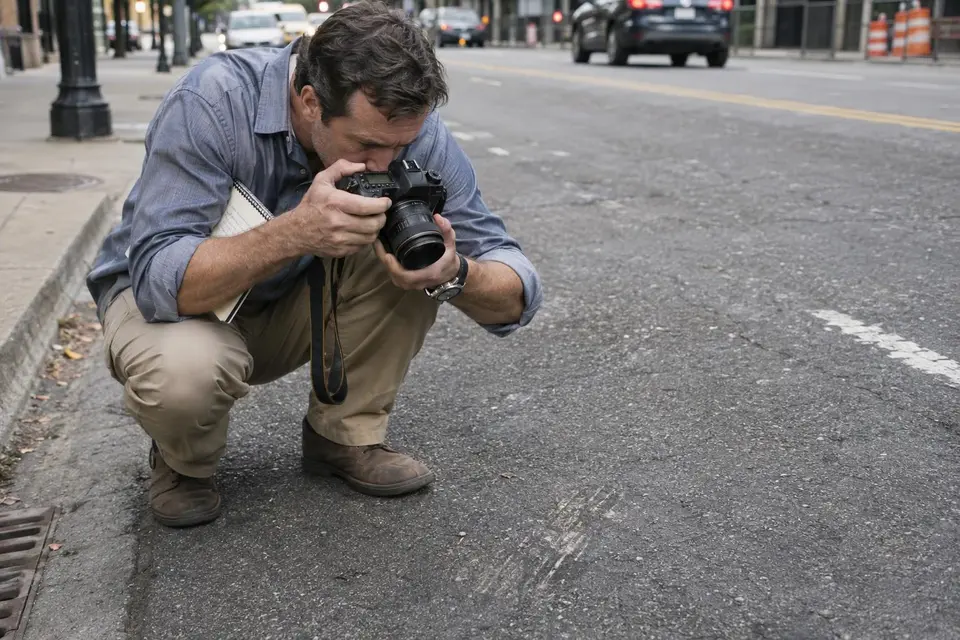
You do not have to argue with an officer or insist that the pedestrian had no responsibility to ask for a closer look. What could the driver see? Was the speed reasonable for the conditions? Were the lamps lit? A person struck between intersections is still a person the driver owed care to.
Closing Remarks
If the words "not in a crosswalk" have left your family unsure what to do, you can start with the report and the questions it leaves unanswered. You do not need to know who was at fault before you ask for help.
At CDB Injury Law, Chris DeBari can walk you through what the evidence shows, what may still be missing, and which deadlines matter. We can handle conversations with the insurer so you have room to grieve or heal. When you're ready to talk about your recovery, contact us through our contact page. You do not have to face this alone.
Frequently Asked Questions
Does crossing outside a crosswalk end a pedestrian injury claim in Florida?
No. Outside a marked crosswalk or an unmarked crosswalk at an intersection, Fla. Stat. § 316.130(10) requires the pedestrian to yield to vehicles on the roadway. Subsection (15) still requires the driver to use due care to avoid a collision. For negligence lawsuits filed after March 24, 2023, the pedestrian's own fault reduces damages proportionately and bars recovery only if it exceeds 50 percent (§ 768.81).
Is crossing midblock always illegal?
No. The Florida statute does not use the word "jaywalking." Between adjacent intersections where traffic signals are operating at both intersections, pedestrians may cross only in a marked crosswalk (§ 316.130(11)). On other blocks, a pedestrian crossing midblock outside a marked crosswalk must yield to vehicles on the roadway (§ 316.130(10)). Except in a marked crosswalk, the pedestrian must cross at right angles to the curb or by the shortest route to the opposite curb (§ 316.130(12)).
The intersection had no painted lines. Was there still a crosswalk?
Possibly. The definition of "crosswalk" in Fla. Stat. § 316.003 includes the part of a roadway at an intersection within the connections of the lateral lines of the sidewalks on opposite sides of the highway, measured from the curbs or, if there are no curbs, from the edges of the traversable roadway. Paint is not required for that kind of crosswalk. A marked crosswalk, by contrast, can exist at an intersection or elsewhere, including midblock.
What if the driver was traveling under the posted speed limit?
That does not resolve the question. Fla. Stat. § 316.185 states that a speed lower than the prescribed limit does not relieve the driver of the duty to decrease speed when special hazards exist or may exist involving pedestrians, weather, or roadway conditions, and § 316.183(4)(e) requires an appropriately reduced speed when such a hazard exists. In rain or darkness, on a curve, or near a hill crest, even a speed below the limit can be too fast for the conditions.
Does a traffic citation decide who was negligent?
No. A ticket is not a civil verdict. Fla. Std. Jury Instr. (Civ.) 401.9 addresses the underlying conduct: if jurors find that the driver or pedestrian violated a traffic rule, they may consider that violation alongside the other facts. It does not prove negligence on its own.
References
- Crash reports; public records exemption (Fla. Stat. § 316.066)
- Definitions (Fla. Stat. § 316.003)
- Pedestrians; traffic regulations (Fla. Stat. § 316.130)
- Unlawful speed (Fla. Stat. § 316.183)
- Special hazards (Fla. Stat. § 316.185)
- When lighted lamps are required (Fla. Stat. § 316.217)
- Careful and prudent operation (Fla. Stat. § 316.1925)
- Wireless communications while driving (Fla. Stat. § 316.305)
- School and work zones; prohibition on handheld use of wireless communications devices (Fla. Stat. § 316.306)
- Waiver of sovereign immunity in tort actions (Fla. Stat. § 768.28)
- Comparative fault (Fla. Stat. § 768.81)
- Limitations other than for the recovery of real property (Fla. Stat. § 95.11)